When Obedience Costs You Everything - What Queen Esther Taught Me After I Quit My Job
Legacy Letter Series | by Jerica A. David
“If you remain silent at this time, relief and deliverance will arise from another place… but who knows whether you have come to your position for such a time as this?” - Esther 4:14
The Week I Finally Walked Away
Last week, I resigned from the company I represented for six years.
A friend messaged, “Thank God. I never thought that company fit you.”
Maybe. But quitting wasn’t about comfort; it was about conscience.
For years, I worked as a financial advisor, bridging the gap between Filipino families and insurance institutions. My clients trusted that I would deliver what the system promised: protection, transparency, and peace of mind.
Yet more often than not, I found myself protecting clients from the very bureaucracy meant to protect them.
That disconnect broke something in me.
You can’t keep preaching stewardship while the structure rewards delay and confusion.
So I walked away… not because I was done with my calling, but because I wanted to do it clean.
When Floods Reveal What We’ve Been Building On
Days before my resignation, the headlines turned darker.
The flood-control scandal was no longer an abstract story about ghost projects — it began to show its faces, its meetings, its hotel hallways.
Reports emerged of approximately PHP 1 billion of cash-filled luggages being wheeled out of Shangri-La, BGC, to former Congressman Zaldy Co’s penthouse.
Names like Zaldy Co and Martin Romualdez surfaced, men not drowning in floodwater, but in the weight of public suspicion.
While ordinary Filipinos were lifting soaked furniture from living-room floors, the powerful were allegedly lifting money out of luxury suites.
It was the perfect metaphor for our nation:
the poor waist-deep in floodwater, the rich knee-deep in greed.
We didn’t just lose money; we lost moral ground.
When greed becomes acceptable, floods stop being natural disasters: they become national symptoms.
Every broken dike and vanished peso has a paper trail that leads back to one place: our silence.
And that’s when the story of Esther started echoing in my head.

For Such a Time as This: The Legacy of Queen Esther
Esther wasn’t born powerful. She was an orphan in exile who found herself in a palace built on politics.
She didn’t ask for the crown; it was placed on her.
Read her story here.
And when her people were threatened, she hesitated — until her cousin Mordecai told her:
14 For if you keep silent at this time, relief and deliverance will rise for the Jews from another place, but you and your father’s house will perish. And who knows whether you have not come to the kingdom for such a time as this?”
He was reminding her—and all of us—that silence can be complicity.
When we talk about legacy, we often think in terms of inheritance: what we leave behind. But sometimes, legacy is about what we stand up for while we’re still here.
The story of Esther is one of the clearest portraits of legacy in motion. A young woman, orphaned and displaced, rises quietly to power in a foreign empire.
She didn’t plan to be queen. She doesn’t seek influence. Yet her obedience positions her to save an entire nation.
What fascinates me most is that God’s name is never mentioned in her story: no miracles, no commandments—just providence disguised as coincidence.
Esther’s courage wasn’t loud. It was strategic, patient, and deeply spiritual.
She didn’t act out of outrage; she acted out of alignment.
That’s what I want my own obedience to look like: not reactionary, but redemptive.
So when I signed that resignation letter, I wasn’t escaping a system—I was stepping into my own Esther moment.
The Mirror: What This Says About Us
We Filipinos have learned to normalize corruption the way we normalize traffic.
We scroll past scandal after scandal, criticize through comments and move on.
But silence is not survival; it’s surrender.
The flood-control scandal isn’t just about contractors or senators: it’s about culture.
The culture of “lahat naman gumagawa niyan.”
The culture that allows small thefts to go unnoticed in families while condemning the big ones on TV.
Our problem isn’t the lack of engineers—it’s the lack of moral courage.
And Yet, Hope Remains
In the swirl of scandal and national disillusionment, a quiet hope persists: people within the system choosing integrity over comfort.
In September, thousands flooded the streets of Manila and other cities in the so-called “Trillion Peso March” and “Baha sa Luneta” protests—calling out anomalies in flood-control projects and demanding accountability.
Engineering staff and mid-level members of the Department of Public Works and Highways (DPWH) quietly raised concerns.
Witnesses in Senate hearings testified: former government engineers admitted projects were substandard or inflated, and they sought whistleblower protection.
This morning, I saw an interview with Congressman Leandro Leviste.
One voice stands out: Congressman Leandro Leviste of Batangas’s 1st district. He didn’t just condemn the system; he exposed it.
He publicly filed charges against a district engineer who allegedly attempted to bribe his office to cover up flood-control anomalies.
He called the engineer a “pawn of big fish,” naming the larger culture of kickbacks and falsified bidding in his district.
For the young politicians reading this: Leviste’s example is more than headline news, it’s a blueprint.
It demonstrates that integrity isn’t a sidebar in politics. It must become mandatory equipment. He turned investigation into accountability.
He turned exposure into reform.
I don’t write this to condemn the many public servants I know who entered with noble goals. My friends, my relatives, my clients—they are in the system, doing good work quietly. I write this to recognize them.
Because when culture shifts, it often begins inside the institution, not outside it.
There are still Daniels in Babylon, Esthers in the palace, Nehemiahs rebuilding walls at night while no one watches.
They deserve our recognition—not because they’re perfect, but because they refuse submission to compromise. They are proof that hope remains.
Legacy Isn’t Later—It’s Now
We talk about legacy like it’s a retirement project.
But Esther’s story shows that legacy begins the moment we choose conviction over comfort.
For me, resigning was an act of faith. It meant trusting that my family’s future doesn’t depend on commissions or corporate favor, but on character.
It meant believing that God can provide without me compromising.
I’m still a financial planner, but now, I’m rebuilding from a cleaner foundation: one rooted in Biblical stewardship, ethical advising, and generational integrity.
Because our nation doesn’t just need better products; it needs principled advisors who can help Filipino families transfer not just assets—but values.
The Real Battle We Face
Our enemy isn’t the corrupt contractor, the lazy bureaucrat, or the broken system.
It’s the spirit behind them—the unseen forces that twist purpose into profit.
In the Philippines today, the unfolding scandal involving flood-control projects is exposing this moral decay. Billions diverted, ghost projects built, lives lost in floods, the Filipino people betrayed.
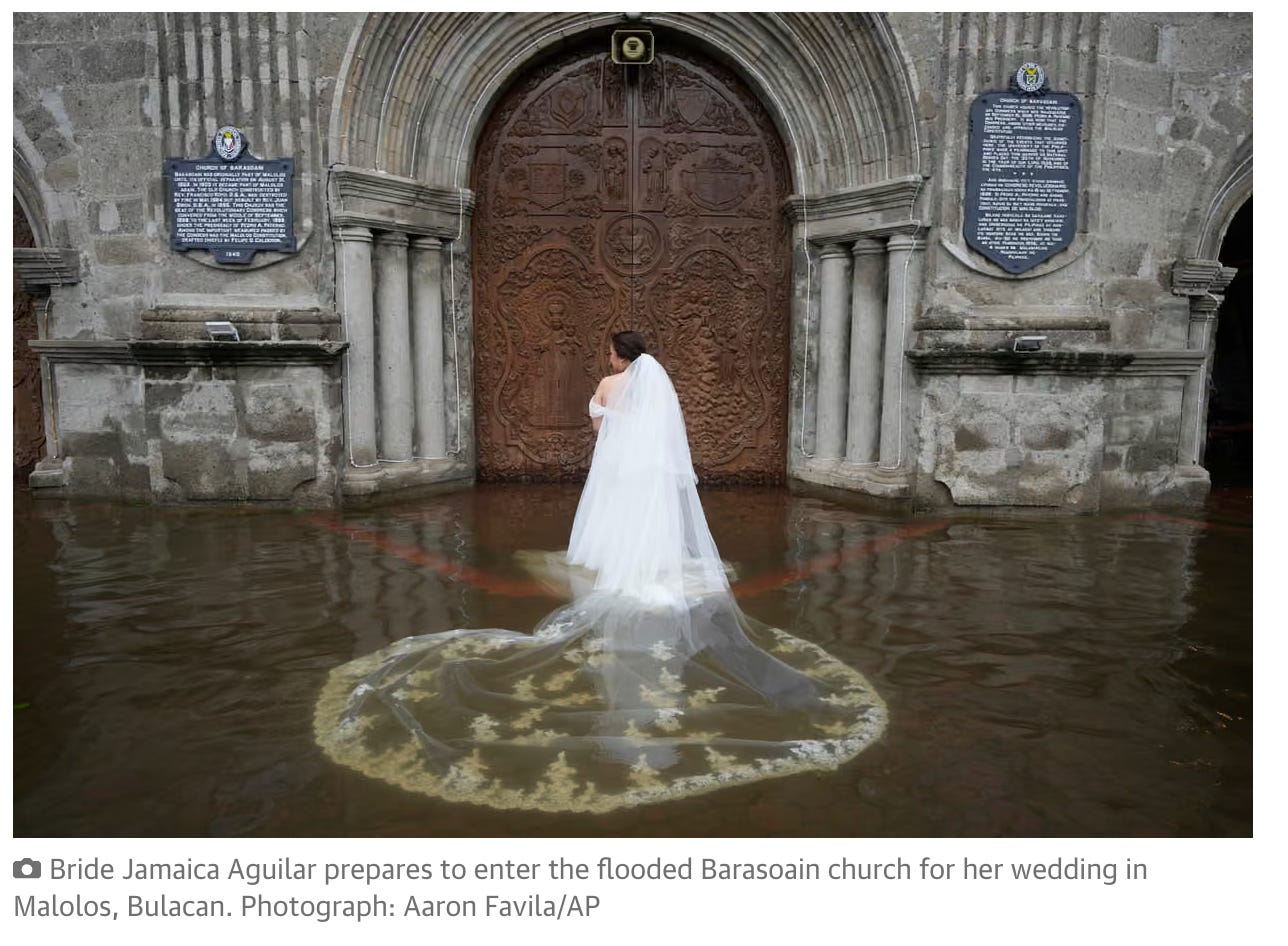
Picture Source: https://www.theguardian.com/
Billions meant to protect citizens became flashing wealth for the few.
And we watch, mostly silent.
The message from Esther holds: silence is not neutral.
Deliverance begins when someone decides to speak.
Corruption won’t be solved merely with laws.
It’s healed when households choose stewardship over status.
By parents who teach that dignity isn’t in accumulation but in accountability.
When mothers and fathers show that conscience, not comfort, builds a legacy.
Esther’s Lesson for Every Filipino Mother
Obedience often looks reckless before it looks right.
Faith doesn’t always close chapters neatly—it sometimes tears them open to show what’s been festering underneath.
But when you stop bowing to fear, you make room for providence.
That’s what Esther did: she simply showed up, not knowing the outcome.
That’s what I want my daughters to see—that showing up in truth is how legacies are written.
Legacy Is Lived, Not Left
We love to talk about legacy as if it’s something we build later, once the chaos settles.
But Esther didn’t wait for perfect timing. She risked her position at the peak of her influence.
Legacy happens when you choose obedience in the middle of uncertainty.
For me, walking away was an act of worship. It meant trusting that God’s favor isn’t tied to corporate approval or commissions.
It’s tied to alignment.
Alignment with His timing. His truth. His standard.
And maybe that’s what legacy really is: not the wealth we accumulate, but the alignment we maintain—when no one’s clapping, when no one’s watching.
What I Learned After Resigning
I realized that obedience often looks reckless before it looks right.
Faith doesn’t always close chapters neatly—it sometimes rips them open to reveal what’s been festering underneath.
But when you stop bowing to fear, you make room for providence.
You begin to see that miracles often look like detours.
Esther didn’t know if she’d survive the throne room.
I didn’t know what would come after walking away.
But both of us learned that obedience is rarely convenient—and always consequential.
Legacy works the same way: quiet, costly, and courageous.
It’s not about looking strong; it’s about standing still long enough for God to move.
My Prayer for This Season
If you’re in a place that no longer aligns with who God called you to be,
don’t rush—but don’t rationalize either.
Maybe He’s not asking you to leave. Maybe He’s asking you to lead differently.
But if He is calling you to walk away, trust that your obedience is never wasted.
Because every Esther moment comes with risk—and every act of faith creates ripples that outlast comfort.
I’m still rebuilding. Some days that looks like cleaning up spreadsheets instead of strategy decks.
Other days, it’s helping clients rediscover purpose behind their plans.
Most days, it’s tucking my daughters into bed and praying they’ll grow up in a country that values honesty more than hierarchy.
So this is where I am now: rebuilding, realigning, and relearning what it means to live my legacy, not just plan it.
If you’re standing at your own “for such a time as this” crossroad, know this:
“If you remain silent at this time, deliverance will arise from another place.”
Courage will always demand something from you: comfort, safety, applause.
But silence demands far more—it takes your voice, your witness, and eventually, your soul.
I still believe Filipino families can rebuild integrity, one household at a time.
It doesn’t begin in Congress or in courtrooms.
It begins in the kitchen table, decisions no one else will ever see:
one honest act,
one clean transaction,
one quiet refusal to participate in the rot.
That’s how nations turn—not through noise, but through conscience.
If this vision stirs something in you, subscribe to The Legacy Letter.
Because every home that chooses truth over convenience becomes a fortress of grace in a culture of greed.
Let’s raise heirs of courage, not consumption.
Stewards, not spectators.
Legacies that flood generations—with grace instead of greed.
🙏 Praying for peace, discernment, and courage.
— Jerica